
Live Labs 2 blog – East Riding of Yorkshire Council’s Decarbonising Street Lighting project update
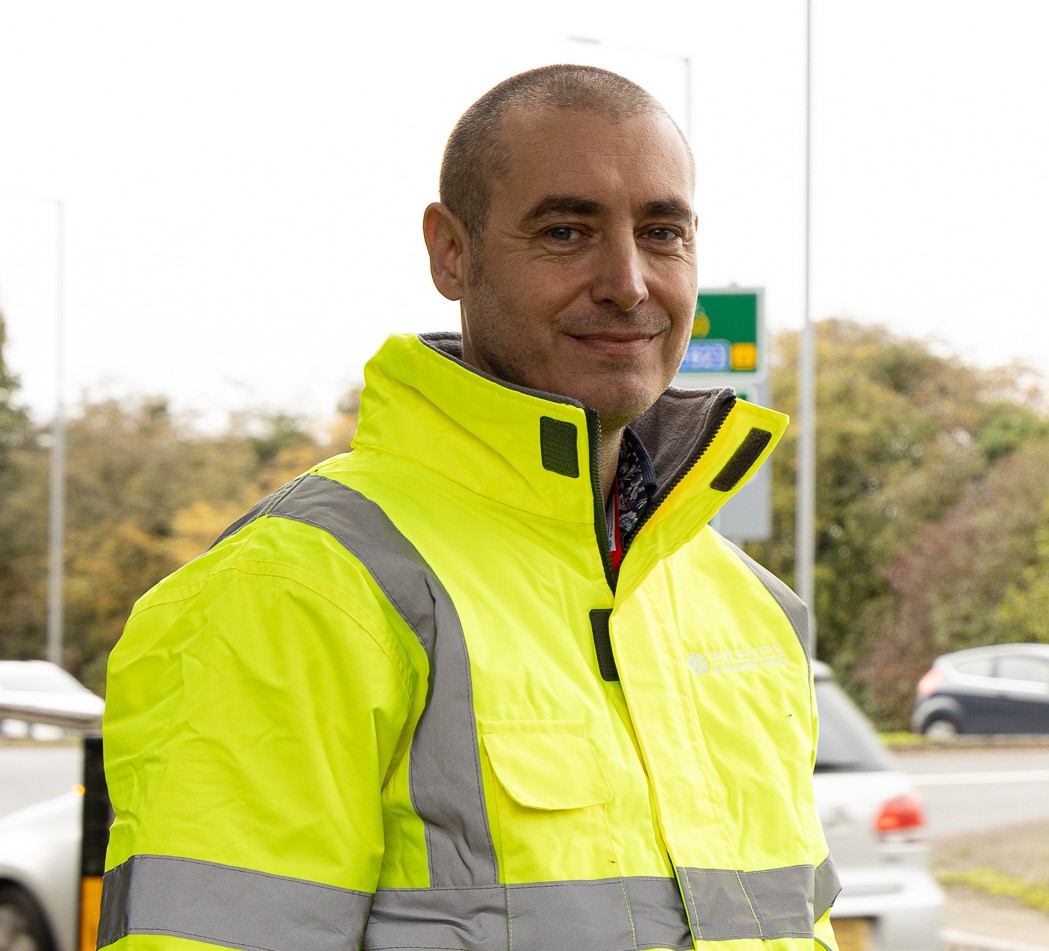
This month’s blog comes from Karl Rourke, the project lead for the East Riding of Yorkshire Council’s Decarbonising Street Lighting project.
Now that we are reaching the end of the third and final year of our project to investigate whether it’s possible to replace street lighting with low carbon, highly visual alternatives, it’s the perfect opportunity to look back and review how the project has progressed and how far we have come in such a short period of time.
Whilst year two was the year of deployment, year three has been very much the year of data collection and number crunching. There has been extensive work undertaken by our academic and commercial partners along with East Riding officers to support and develop the assessment tools and data collection needed for a project that goes against the grain of years of design, custom and practice.
Millions of lines of data have come into the project across a range of work streams and both national and world firsts have been deployed. Through the data collection, our dissemination of it and the benefits that our approach has already shown, we are changing attitudes across the highways lighting sector and have our first early adopters on board.
Right light, right place, right time
In our previous project update blog, I made reference to our pedestrian-only lighting trials that were going live at the time of writing. They have now been running for 10 months, and the responses have been overwhelmingly positive.
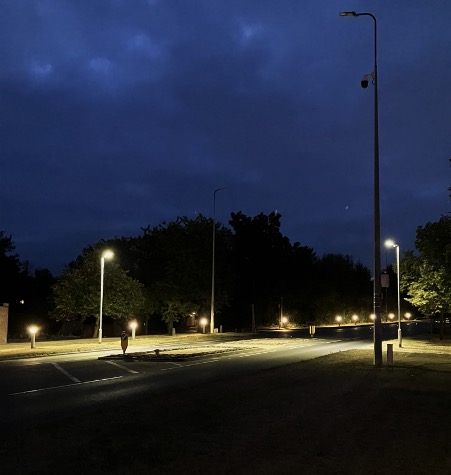
Across the areas where pedestrian-only lighting has been installed, nighttime user numbers have increased and local feedback, including comments such as “finally something designed for the people that use it”, has been strikingly positive. Current British Standards for these types of locations/scenarios light the footway as a by-product of lighting the carriageway. We have flipped that around and designed something that is user led and both cost and carbon reduced.
The interesting by-product of the setting in Hayton, where we have also illuminated the uncontrolled crossing point against the dark carriageway, is the behaviour change that it has brought about. When the road was lit in a conventional way, pedestrians would cross this major A road at any point they chose, mostly in unsafe locations. Since the application of the footway lighting and by lighting the crossing point, we now see all crossing actions, both cyclist and pedestrian, taking place at this crossing point. It has completely changed the way that pedestrians and cyclists manage this road crossing during the day and at nighttime.
What are the benefits for motorists?
Using the thermal imaging, AI-based, driver behaviour monitoring system developed for this project we have been able to monitor a range of driver safety indicators, 24/7, both before and after de-illumination. We have seen significant results from this data.
Across our test sites our data shows that driver speeds have reduced compared to when street lighting was present. We can also break this data down into vehicle classifications and it has significant impact on all vehicle types, even motorcyclists. Any reduction in average speed for a motorcyclist increases their chances of survival if they are involved in a collision. I In addition, our data demonstrates a reduction in nighttime collision rates on our test sites compared to previous years.
We will continue to collect data, monitoring and reviewing for a further three years, to prove that traditional road lighting choices are not the best or safest answer to every road safety problem.
Why should a Local Highway Authority adopt this as an option?
We made a conscious effort right from the beginning of the project to address this question; all of our workstreams have been based around it. Whilst the political landscape may have changed since we began this journey, the pressures that local authorities face have not. We believe we have clear, evidence-based reasons for local authorities to put our Live Labs 2 methodology in their suite of options.
Firstly, and the main focus of the project, carbon impact. The East Riding test sites have seen the removal of approximately 450 lighting columns, and through our decision support tool, created in conjunction with Leeds University, we have calculated that the East Riding test sites will save 160 tonnes of C02e in the first ten years of deployment. This takes into account grid decarbonisation on energy, installation and scheduled maintenance of replacement lighting compared to the non-illuminated alternatives.
When considering cost savings, often the belief is that road safety and carbon reduction measures cost more money.
Through our decision support tool, we are able to evidence that by installing the Live Labs 2 equipment rather than replacing the end of life street lighting on our test sites, we will have saved the authority £1.1m over the first ten years of deployment and £1.6m over a forty year period, which would have been the life of the replacement street lighting.
For many reasons, local authorities can be risk averse. We had to consider what would happen if a collision occurred on one of our test sites and we were required to defend our data and implementation.
Throughout the project we have included representatives from both our insurers and our highway specialist solicitors into our project working groups to address this.
At the end of 2025 those representatives have drafted reports for the project focussing on:
- our approach to risk management from our insurers
- and our legally defensible position from our solicitors.
Both documents are part of our final project reporting, and both showed positive responses to this researched method of de-illumination that puts user safety at its core.
Exploring the impact on road safety
Through our detailed data collection and ever-growing road safety evidence, that will continue to grow long after this project is finished, we are able to show a very clear picture of the impact on driver behaviour. From the conventional approach to lighting, to the new strategy of targeted visual intervention, the impact of speed reductions is evident.
This is particularly true when you compare the roundabouts where we have applied our new method and have seen speeds reduce. Other roundabouts on the same road, with the same users and traditional lighting in place, show no change in driver speeds at all.
We appreciate this is not an approach that can be applied everywhere; the social factors surrounding street lighting mean that we would not advocate this solution for every scenario. However, in East Riding we are looking to expand on this Live Labs 2 project. We have already identified a further 2,500 streetlights in similar locations to our test beds that are earmarked for replacement with the Live Labs 2 methodology.
Those 2,500 lighting columns alone will save the local authority between £5-6m within the first ten years.
With so many positive indicators surrounding this approach it really is a tried and tested solution for local authorities to explore, adopt and have in their options for business as usual. Just because there were street lights there before doesn’t necessarily mean that a straight replacement is the best solution.
At the culmination of this amazing programme and as a lighting professional, this project has changed my perception of how we provide our service for residents and communities. Maybe the way we have always done it is open to challenge and change and isn’t the way we should carry on doing it.
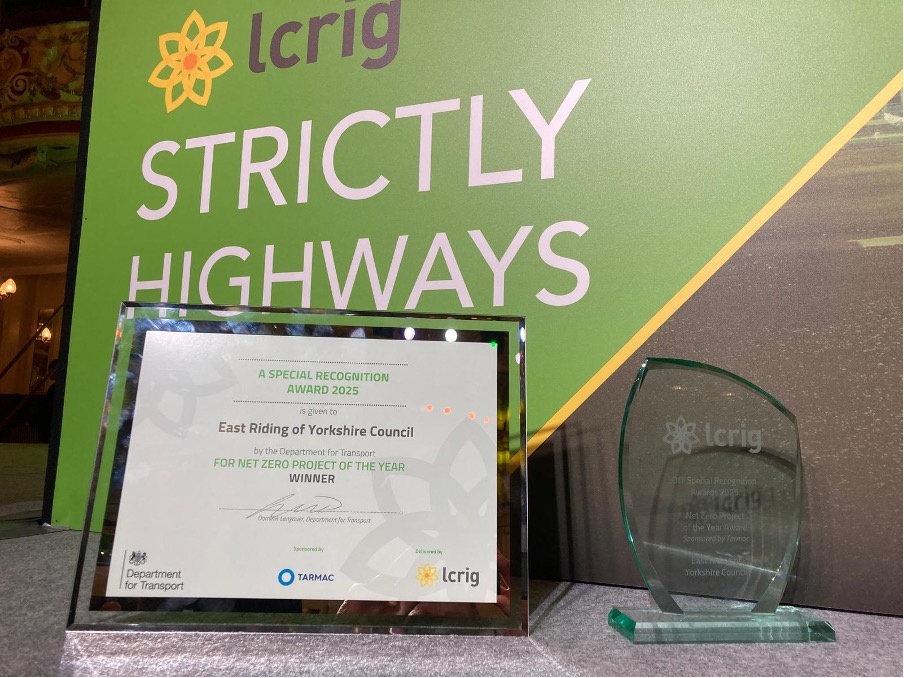
It has been incredibly rewarding to see our hard work being recognised on a national level with the project picking up three significant national awards in the last twelve months and the potential of more to come.
Further information
- For more information on ADEPT Live Labs 2: Decarbonising Local Roads in the UK, please look at the Live Labs 2 section on the website
- Explore more about the East Riding Live Labs 2 project here
- You can discover more about the Live Labs 2 Decarbonisation of Highways Pledge here and the launch event at Westminster here
Author
Karl Rourke, is the project lead for East Riding of Yorkshire Council’s Decarbonising Street Lighting project.